Statement of Account
Those are this report's own sheets, printed by the engine from the template and the payload below — not screenshots kept beside them.
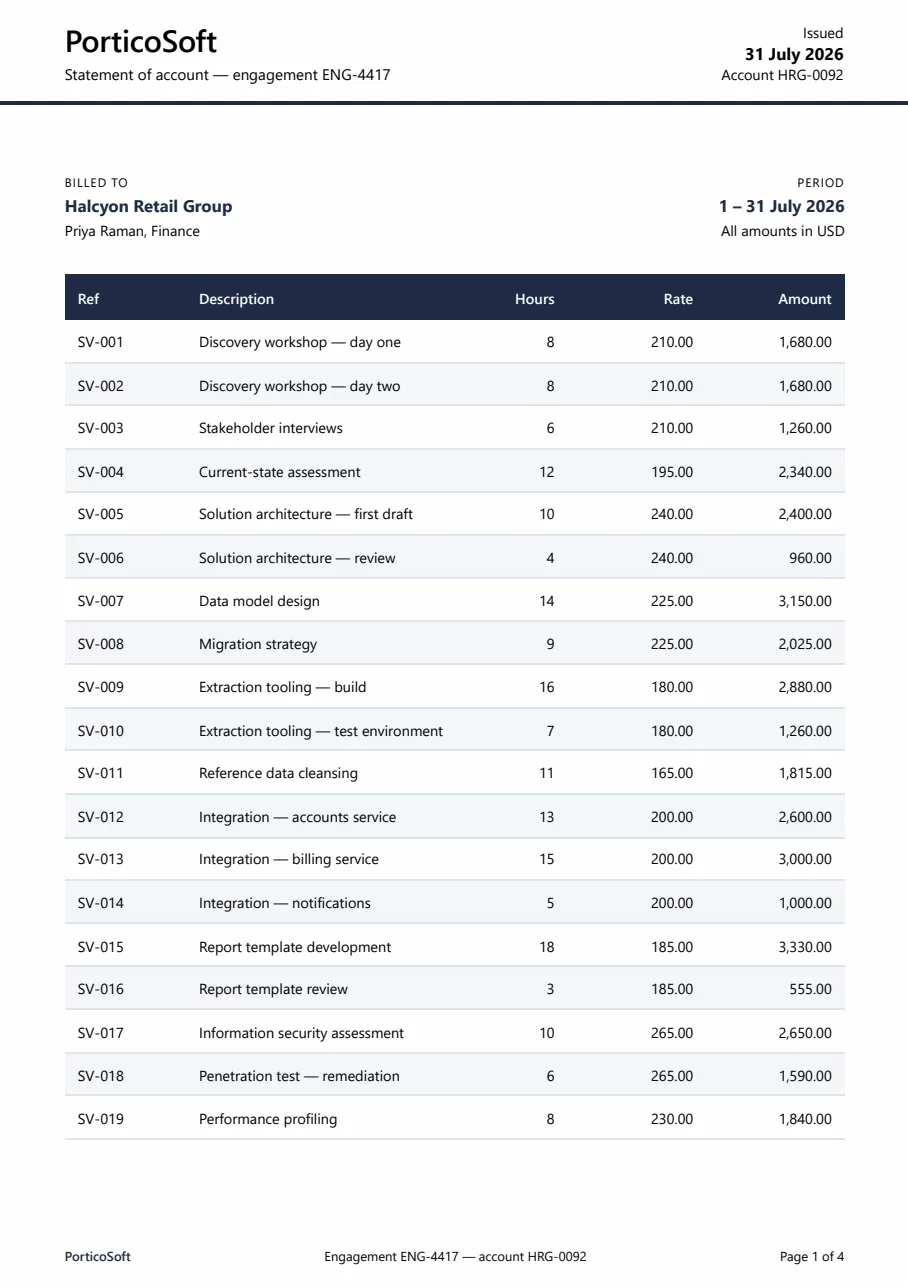
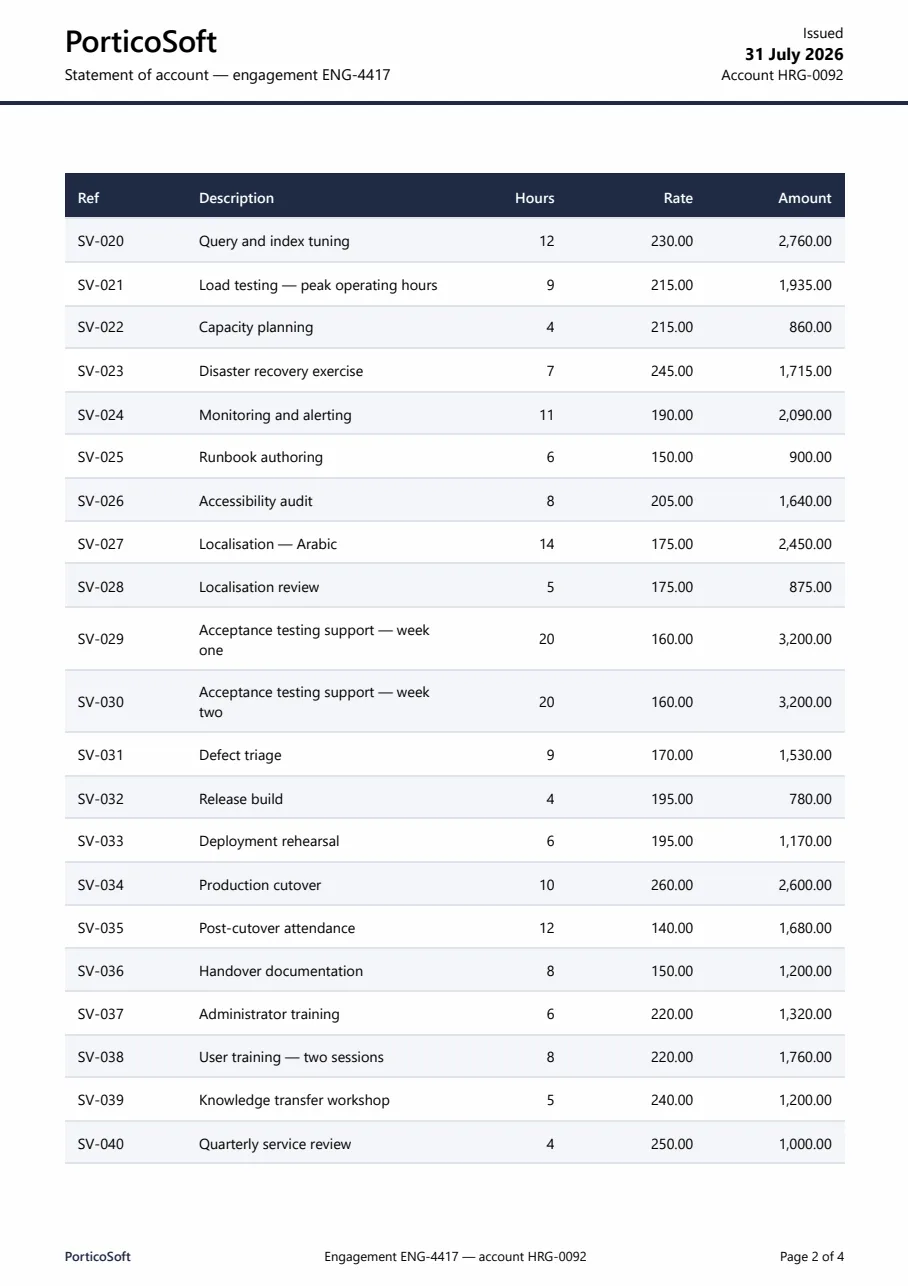
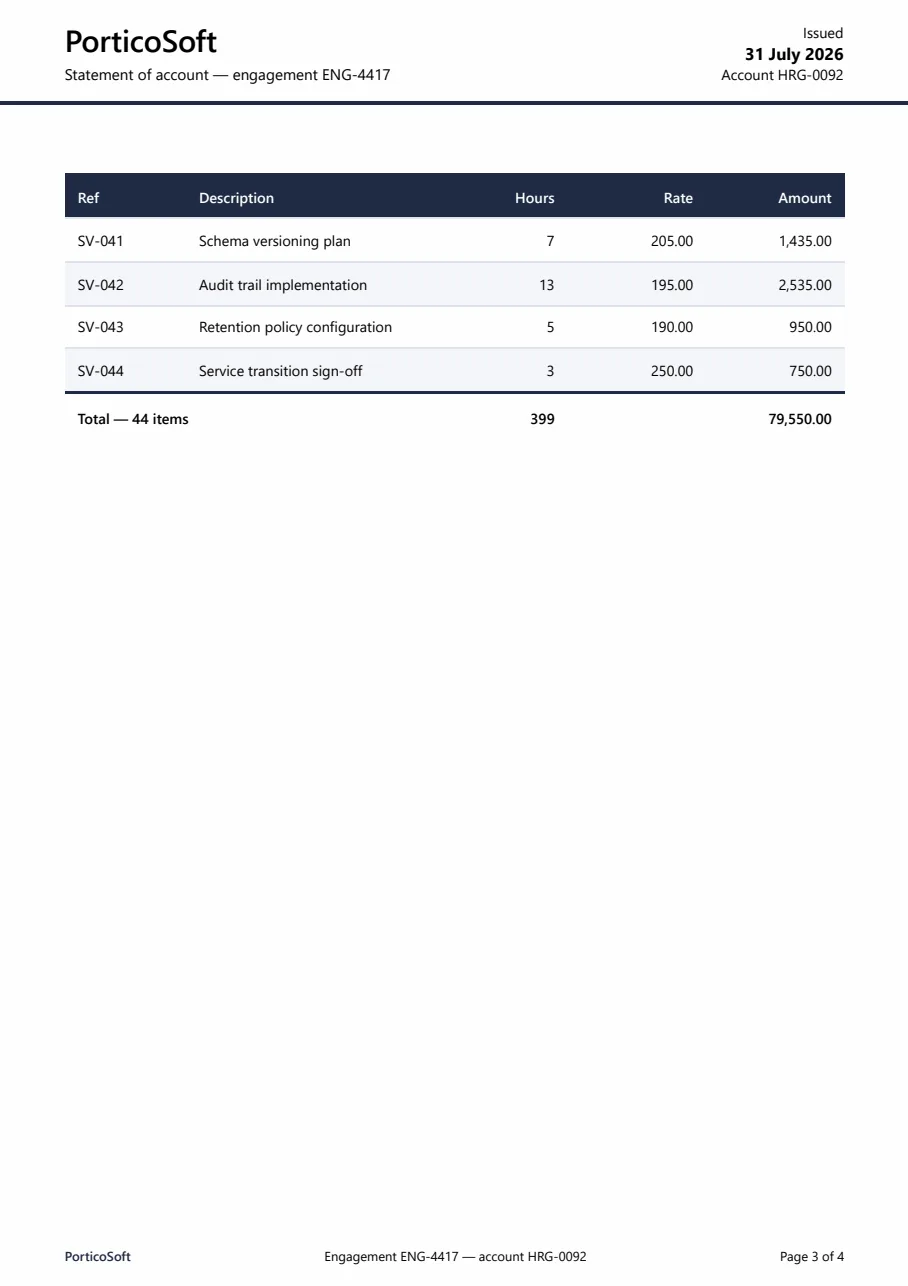
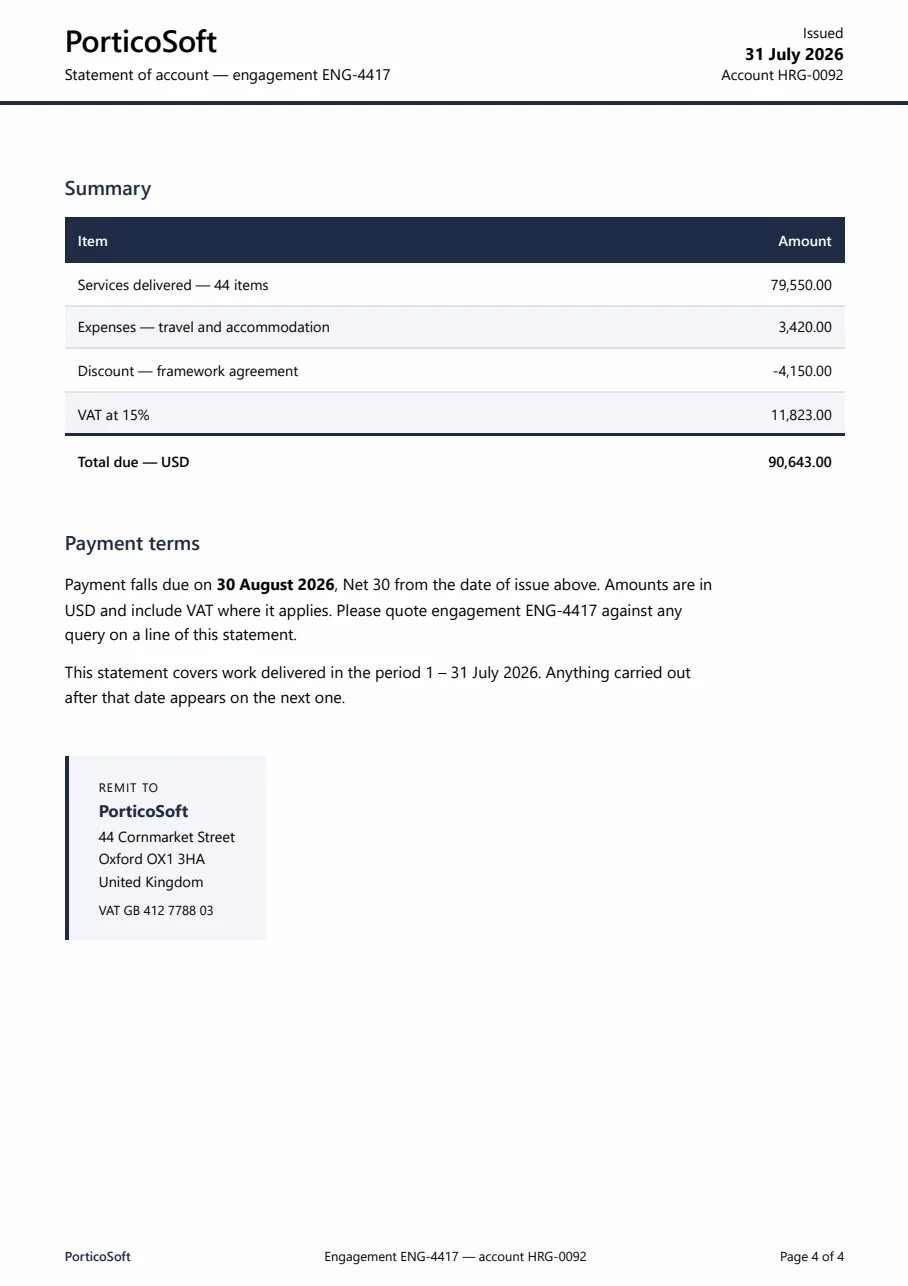
The source
This is the whole thing — the template, the pages that print from it, and the stylesheet
they are dressed in, as HTML with {{ }} bindings. Nothing is generated from a
designer format; what you see here is what the engine renders.
template.html
<!DOCTYPE html>
<html>
<head>
<meta charset="utf-8">
<link rel="stylesheet" href="assets/css/report.css">
</head>
<body>
<script id="report-data" type="application/json">{{json}}</script>
<template id="report-header">
<header class="masthead">
<div>
<h1>{{issuer.name}}</h1>
<p class="subject">{{statement.title}} — engagement {{statement.engagement}}</p>
</div>
<div class="issued">
Issued <strong>{{date statement.issued "d MMMM yyyy"}}</strong>
Account {{statement.account}}
</div>
</header>
</template>
<template id="report-footer">
<div class="pagefoot">
<span class="mark">{{issuer.name}}</span>
<span>Engagement {{statement.engagement}} — account {{statement.account}}</span>
<span>Page <span class="pageNumber"></span> of <span class="totalPages"></span></span>
</div>
</template>
</body>
</html>
page1.html
<div class="sheet">
<div class="addressed">
<div>
<span class="label">Billed to</span>
<strong>{{statement.client}}</strong>
<span>{{statement.contact}}</span>
</div>
<div>
<span class="label">Period</span>
<strong>{{statement.period}}</strong>
<span>All amounts in {{statement.currency}}</span>
</div>
</div>
<table class="ledger">
<thead>
<tr>
<th class="ref">Ref</th>
<th>Description</th>
<th class="qty num">Hours</th>
<th class="money num">Rate</th>
<th class="money num">Amount</th>
</tr>
</thead>
<tbody>
{{#each items}}
<tr>
<td class="ref">{{ref}}</td>
<td>{{description}}</td>
<td class="qty num">{{hours}}</td>
<td class="money num">{{number rate "N2"}}</td>
<td class="money num">{{number amount "N2"}}</td>
</tr>
{{/each}}
</tbody>
<tfoot>
<tr>
<td colspan="2">Total — {{totals.count}} items</td>
<td class="qty num">{{totals.hours}}</td>
<td class="money num"></td>
<td class="money num">{{number totals.amount "N2"}}</td>
</tr>
</tfoot>
</table>
</div>
page2.html
<div class="sheet">
<h2 class="page-title">Summary</h2>
<table class="ledger">
<thead>
<tr>
<th>Item</th>
<th class="money num">Amount</th>
</tr>
</thead>
<tbody>
{{#each summary}}
<tr>
<td>{{label}}</td>
<td class="money num">{{number amount "N2"}}</td>
</tr>
{{/each}}
</tbody>
<tfoot>
<tr>
<td>Total due — {{statement.currency}}</td>
<td class="money num">{{number due.amount "N2"}}</td>
</tr>
</tfoot>
</table>
<h2 class="page-title">Payment terms</h2>
<p class="note">
Payment falls due on <strong>{{date due.on "d MMMM yyyy"}}</strong>, {{due.terms}} from the date
of issue above. Amounts are in {{statement.currency}} and include VAT where it applies. Please
quote engagement {{statement.engagement}} against any query on a line of this statement.
</p>
<p class="note">
This statement covers work delivered in the period {{statement.period}}. Anything carried out
after that date appears on the next one.
</p>
<div class="remit">
<span class="label">Remit to</span>
<strong>{{issuer.name}}</strong>
{{#each issuer.address}}
<span>{{this}}</span>
{{/each}}
<span class="reg">VAT {{issuer.registration}}</span>
</div>
</div>
assets/css/report.css
body
{
  margin: 0;
  font: 10.5pt "Segoe UI", system-ui, sans-serif;
  color: #000000;
}

.sheet
{
  padding: 40mm 15mm 26mm;
  -webkit-box-decoration-break: clone;
  box-decoration-break: clone;
}

/* ---------- header ---------- */

.masthead
{
  height: 24mm;
  box-sizing: border-box;
  padding: 12mm 15mm 4mm;
  background: #fff;

  display: flex;
  align-items: flex-end;
  justify-content: space-between;
  gap: 8mm;
  border-bottom: 0.8mm solid #1f2a44;
}

.masthead h1
{
  margin: 0;
  font-size: 20pt;
  font-weight: 600;
  letter-spacing: -.01em;
}

.masthead .subject
{
  margin: 1mm 0 0;
  color: #000000;
  font-size: 10pt;
}

.masthead .issued
{
  text-align: end;
  color: #000000;
  font-size: 9.5pt;
  white-space: nowrap;
}

.masthead .issued strong
{
  display: block;
  color: #000000;
  font-size: 11pt;
}

/* ---------- footer ---------- */

.pagefoot
{
  display: flex;
  justify-content: space-between;
  box-sizing: border-box;
  width: 100%;
  padding: 0 15mm;
  font: 8.5pt "Segoe UI", system-ui, sans-serif;
  color: #000000;
}

.pagefoot .mark
{
  color: #1f2a44;
  font-weight: 600;
}

/* ---------- page copy ---------- */

.addressed
{
  display: flex;
  justify-content: space-between;
  gap: 10mm;
  margin: 0 0 8mm;
}

.addressed div
{
  display: flex;
  flex-direction: column;
  gap: 0.8mm;
  font-size: 9.5pt;
  color: #000000;
}

.addressed div:last-child
{
  text-align: end;
}

.label
{
  color: #000000;
  font-size: 8pt;
  letter-spacing: .08em;
  text-transform: uppercase;
}

.addressed strong,
.remit strong
{
  font-size: 11pt;
  color: #1f2a44;
}

.remit
{
  display: inline-flex;
  flex-direction: column;
  gap: 0.8mm;
  margin-top: 8mm;
  padding: 5mm 7mm;
  border-inline-start: 0.8mm solid #1f2a44;
  background: #f4f6fa;
  font-size: 9.5pt;
  color: #000000;
}

.remit .reg
{
  margin-top: 1.5mm;
  color: #000000;
  font-size: 8.5pt;
}

.page-title
{
  margin: 0 0 4mm;
  font-size: 13pt;
  font-weight: 600;
  color: #1f2a44;
}

/* Space above a heading that follows something, so the two do not run together. */
.ledger + .page-title
{
  margin-top: 10mm;
}

.note
{
  margin: 0 0 3mm;
  max-width: 150mm;
  line-height: 1.55;
  color: #000000;
}

/* ---------- table ---------- */

.ledger
{
  width: 100%;

  border-collapse: collapse;
  table-layout: fixed;
  font-size: 9.5pt;
}

.ledger thead
{
  display: table-header-group;
}

.ledger thead th
{
  padding: 3mm;
  background: #1f2a44;
  color: #fff;
  font-weight: 600;
  text-align: start;
}

/* Never leave half a row on one sheet and half of it on the next. */
.ledger tr
{
  break-inside: avoid;
}

.ledger td
{
  padding: 2.6mm 3mm;
  border-bottom: 0.25mm solid #dfe3ea;
}

.ledger tbody tr:nth-child(even) td
{
  background: #f4f6fa;
}

/* Figures line up when they are all the same width. */
.ledger .num
{
  text-align: end;
  font-variant-numeric: tabular-nums;
}

/*
  Width on the column, colour on the body cells only. The header cell wears this class as well,
  and two classes out-specify .ledger thead th — so colouring the class rather than the td left
  the Ref heading dark against the band while every other heading was white.
*/
.ledger .ref
{
  width: 22mm;
}

.ledger td.ref
{
  color: #000000;
}

.ledger .qty
{
  width: 18mm;
}

.ledger .money
{
  width: 26mm;
}

.ledger tfoot
{
  display: table-row-group;
}

/* break-inside keeps the total whole rather than splitting it across the seam. */
.ledger tfoot td
{
  padding: 3.4mm 3mm;
  border-top: 0.6mm solid #1f2a44;
  border-bottom: 0;
  font-weight: 600;
}
shared-assets/css/house.css
/*
  The project's house style: what every report in it looks like before it looks like itself.

  It is in shared-assets rather than in a report because it is the project's, not one report's —
  the palette, the type, the sheet, the running header, and the handful of parts (card, chip, pill,
  meter, table) that every report here is assembled from. A report's own stylesheet composes these
  into its layout; it does not redecide what a card is.

  A template references it as assets/css/house.css, exactly as it references its own files. The
  shared folder is searched behind the report's own, so the path means the same thing in every
  report — and a report that needs its own version keeps a file at that path and wins.
*/

:root
{
  /* Named for the job, not the hue, so a rebrand is this block and nothing else. */
  --ink: #0f172a;
  --ink-soft: #475569;
  --ink-faint: #6b7a90;
  --ink-invert: #ffffff;

  --page: #ffffff;
  --panel: #ffffff;
  --panel-2: #f8fafc;
  --rule: #e2e8f0;
  --rule-soft: #eef2f7;

  --brand: #0b1f3a;
  --brand-2: #12325c;
  --accent: #1d4ed8;
  --accent-soft: #eef3ff;
  --cyan: #0ea5e9;

  --good: #047857;
  --good-soft: #e7f6f0;
  --warn: #b45309;
  --warn-soft: #fdf3e3;
  --bad: #b91c1c;
  --bad-soft: #fdeceb;
  --idle: #64748b;
  --idle-soft: #f1f5f9;

  --radius: 7px;
  --radius-sm: 4px;
}

body
{
  margin: 0;
  color: var(--ink);
  background: var(--page);

  /*
    No Arabic face here, and no Arabic font in shared-assets at all. Naming one for every report in
    the project meant seven reports asked for a typeface none of them loads, so what they actually
    printed in was the second name in the list. The one Arabic report carries the family and the
    files itself.
  */
  font-family: "Segoe UI", Tahoma, sans-serif;
  font-size: 11px;
  line-height: 1.55;

  /* Every figure in this project is read down a column, so digits are the same width. */
  font-variant-numeric: tabular-nums;
  -webkit-font-smoothing: antialiased;
}

/*
  The sheet.

  The engine prints with no page margin, so the edges are the report's own to leave. Cloned decoration
  keeps the padding on every sheet a long page runs onto rather than only the first, and the top
  padding is what the fixed running header sits in — it reserves no room of its own.
*/
.sheet
{
  box-sizing: border-box;
  width: 794px;
  min-height: 1123px;
  padding: 96px 40px 44px;

  -webkit-box-decoration-break: clone;
  box-decoration-break: clone;
}

/* ---------- the running header, on every sheet ---------- */

/*
  The engine fixes #report-page-header to the top of the sheet; everything below is this project's
  band inside it. A band rather than a line of text: it is the first thing on every page and the
  only thing carrying the mark, and at 76px it is still under a fifteenth of the sheet.
*/
#report-page-header
{
  height: 76px;
  background: linear-gradient(105deg, var(--brand) 0%, var(--brand-2) 62%, #17416f 100%);
  color: var(--ink-invert);
}

.masthead
{
  display: flex;
  align-items: center;
  gap: 14px;
  height: 73px;
  padding: 0 40px;
  box-sizing: border-box;
}

/* The accent edge, under the band. Three pixels is enough to read as deliberate. */
#report-page-header::after
{
  content: "";
  display: block;
  height: 3px;
  background: linear-gradient(to left, var(--accent), var(--cyan) 55%, rgba(14, 165, 233, 0));
}

.masthead .logo
{
  width: 30px;
  height: 30px;
  flex: 0 0 auto;
}

.masthead .titles
{
  display: flex;
  flex-direction: column;
  gap: 1px;
  min-width: 0;
}

.masthead .org
{
  font-size: 12.5px;
  font-weight: 700;
  letter-spacing: -.005em;
}

.masthead .subject
{
  font-size: 10.5px;
  color: #a9c2e0;
}

.masthead .meta
{
  margin-inline-start: auto;
  display: flex;
  flex-direction: column;
  align-items: flex-end;
  gap: 2px;
  text-align: end;
  white-space: nowrap;
}

.masthead .period
{
  font-size: 11px;
  font-weight: 600;
}

/* A quiet outline rather than a filled badge: it is a caveat, not a headline. */
.masthead .classification
{
  padding: 1px 7px;
  border: 1px solid rgba(255, 255, 255, .34);
  border-radius: 999px;
  font-size: 9px;
  color: #cddcee;
}

/* ---------- the page's own heading, under the band ---------- */

.pagehead
{
  display: flex;
  align-items: flex-end;
  gap: 12px;
  padding-bottom: 9px;
  border-bottom: 1px solid var(--rule);
}

.pagehead h1
{
  margin: 0;
  font-size: 19px;
  font-weight: 700;
  letter-spacing: -.015em;
}

.pagehead .lede
{
  margin: 3px 0 0;
  color: var(--ink-soft);
  font-size: 10.5px;
}

.pagehead .stamp
{
  margin-inline-start: auto;
  color: var(--ink-faint);
  font-size: 10px;
  white-space: nowrap;
}

/* ---------- parts ---------- */

.card
{
  box-sizing: border-box;
  padding: 12px 14px 10px;
  background: var(--panel);
  border: 1px solid var(--rule);
  border-radius: var(--radius);
}

.card-head
{
  display: flex;
  align-items: baseline;
  gap: 8px;
  margin-bottom: 8px;
}

.card h2
{
  margin: 0;
  font-size: 12.5px;
  font-weight: 700;
}

.card .note
{
  margin-inline-start: auto;
  color: var(--ink-faint);
  font-size: 9.5px;
  white-space: nowrap;
}

/* A chart draws itself left to right whatever the page does, and its own labels sit inside it. */
.chart
{
  width: 100%;
  direction: ltr;
}

.chip
{
  display: inline-flex;
  align-items: center;
  gap: 4px;
  padding: 1px 7px;
  border-radius: 999px;
  font-size: 9.5px;
  font-weight: 700;
  line-height: 1.7;
  white-space: nowrap;
}

.chip--good { background: var(--good-soft); color: var(--good); }
.chip--bad  { background: var(--bad-soft);  color: var(--bad); }
.chip--warn { background: var(--warn-soft); color: var(--warn); }
.chip--idle { background: var(--idle-soft); color: var(--idle); }

/*
  A status, as a word with a dot rather than as a filled block: eight of them down a table column
  would otherwise be eight blocks of colour competing with the figures beside them.
*/
.pill
{
  display: inline-flex;
  align-items: center;
  gap: 5px;
  font-size: 10px;
  font-weight: 600;
  white-space: nowrap;
}

.pill::before
{
  content: "";
  width: 7px;
  height: 7px;
  border-radius: 50%;
  background: currentColor;
  flex: 0 0 auto;
}

.pill--good { color: var(--good); }
.pill--warn { color: var(--warn); }
.pill--bad  { color: var(--bad); }
.pill--idle { color: var(--idle); }
.pill--done { color: var(--accent); }

/*
  A proportion, drawn rather than written. Vector, so it stays sharp where a canvas would not — the
  small measures are the ones a reader leans in on.
*/
.meter
{
  height: 5px;
  border-radius: 3px;
  background: var(--rule-soft);
  overflow: hidden;
}

.meter > span
{
  display: block;
  height: 100%;
  border-radius: 3px;
  background: var(--accent);
}

.meter--good > span { background: var(--good); }
.meter--warn > span { background: var(--warn); }
.meter--bad  > span { background: var(--bad); }

/* ---------- tables ---------- */

/*
  Fixed layout and a header group, which is the pair that keeps a long table on the sheet: without
  the first, columns size to their content and the far one runs off the paper; without the second,
  a table that paginates leaves the next sheet as unlabelled columns of numbers.
*/
table.grid
{
  width: 100%;
  table-layout: fixed;
  border-collapse: collapse;
  font-size: 10.5px;
}

table.grid thead { display: table-header-group; }

table.grid tr { break-inside: avoid; }

/*
  Border-box, because a fixed layout takes the width it is given as the whole column: with padding
  added on top instead, six columns quietly cost another 96px and the one column left on auto pays
  for all of it.
*/
table.grid th,
table.grid td { box-sizing: border-box; }

table.grid th
{
  padding: 6px 8px;
  background: var(--panel-2);
  border-bottom: 1px solid var(--rule);
  color: var(--ink-soft);
  font-size: 9.5px;
  font-weight: 700;
  text-align: start;
  white-space: nowrap;
}

table.grid td
{
  padding: 6px 8px;
  border-bottom: 1px solid var(--rule-soft);
  vertical-align: middle;
  overflow-wrap: break-word;
}

table.grid tbody tr:last-child td { border-bottom: 0; }

.num
{
  text-align: end;
  font-weight: 600;
}

/* ---------- the foot of the page ---------- */

.footnote
{
  margin-top: 12px;
  padding-top: 8px;
  border-top: 1px solid var(--rule);
  color: var(--ink-faint);
  font-size: 9.5px;
}

/*
  The running footer, which the browser draws rather than the page.

  It is a document of its own at print time: this stylesheet is read and sent along with it, so type
  and layout arrive, but nothing it would have to fetch does — no webfont, no image, no background.
  So it is set in whatever face the renderer has, and kept to figures and a code, which read the same
  in any of them.
*/
.pagefoot
{
  display: flex;
  align-items: center;
  justify-content: space-between;
  width: 100%;
  padding: 0 40px;
  box-sizing: border-box;
  color: #8a97a8;
  font-family: "Segoe UI", Arial, sans-serif;
  font-size: 8.5px;
  letter-spacing: .04em;
}
What it carries
Stylesheets, scripts, images and fonts travel inside the report, so nothing is resolved
from the outside while it renders. Anything under shared-assets/ belongs to
the project rather than to this report — held once for every report in it, and reached
from the template at the same assets/… path as the report's own.